Image credit: Canva
The idea of starting a blog had been on my mind for years.
I explored different ideas.
I started reading intentionally and looked at what others were doing.
I would get excited about an idea, then put it aside.
I even explored vlogging, for instance. But ultimately settled on writing.
Looking back, I realised the challenge wasn’t a lack of ideas, but something I overlooked.
I realised I was busy thinking about ideas but wasn’t moving from thinking to deciding to acting.
And I suspect this happens to many of us.
When you are engaged in a process like this, you confront yourself with numerous questions. These questions can sometimes create a loop, and you may not even notice that you are caught up in the thinking cycle.
At some point, thinking needs to lead us somewhere.
To move the needle, we need to:
Think → Decide → Act
I wrote about this idea in my previous article:
The Power of Thinking on Paper
A simple habit to clear your mind, make better decisions, and take action
manmohanjoshi.com
But as I thought about my own experience, I realised something else:
We don’t all get stuck in the same place between thinking and acting.
Sometimes we don’t think enough and decide or act quickly.
And sometimes, we think endlessly but never decide or act.
That caused me to explore the different modes we can find ourselves in between thought and action.
Let’s look at these modes and how they shape the way we think, decide, and act.
The Journey from Thought to Action
Every action at first begins with a thought.
A thought arises in our minds. If we find it attractive or important enough, we consider whether to act on it.
Everything in nature wants to survive. Including your thoughts.
— Manmohan Joshi
But not every thought becomes an action.
Some disappear almost as quickly as they arrive.
Others stay with us. We think about them, explore them, question them, and eventually decide whether to act.
Think about something as simple as choosing a movie. We might take a few minutes to decide.
Buying a car is different. We might spend weeks or months researching, comparing, and thinking about the options.
And some decisions can take even longer.
This made me wonder:
What happens in the space between thinking and acting?
Do we move through different modes depending on how thoughtfully we think and how decisively we act?
The Thinking and Decision Matrix
Imagine two dimensions.
Thoughtfulness: How much thought or reflection are you putting into the situation?
Decisiveness: How effective are you at making a decision and moving forward?
Together, these two dimensions can describe where we are in the journey from thought to action.
When we combine these two dimensions, four unique modes emerge.
Let’s understand them one by one.
PS. ‘Action’ is not a separate dimension in the following matrix because it is the outcome we are trying to move toward.
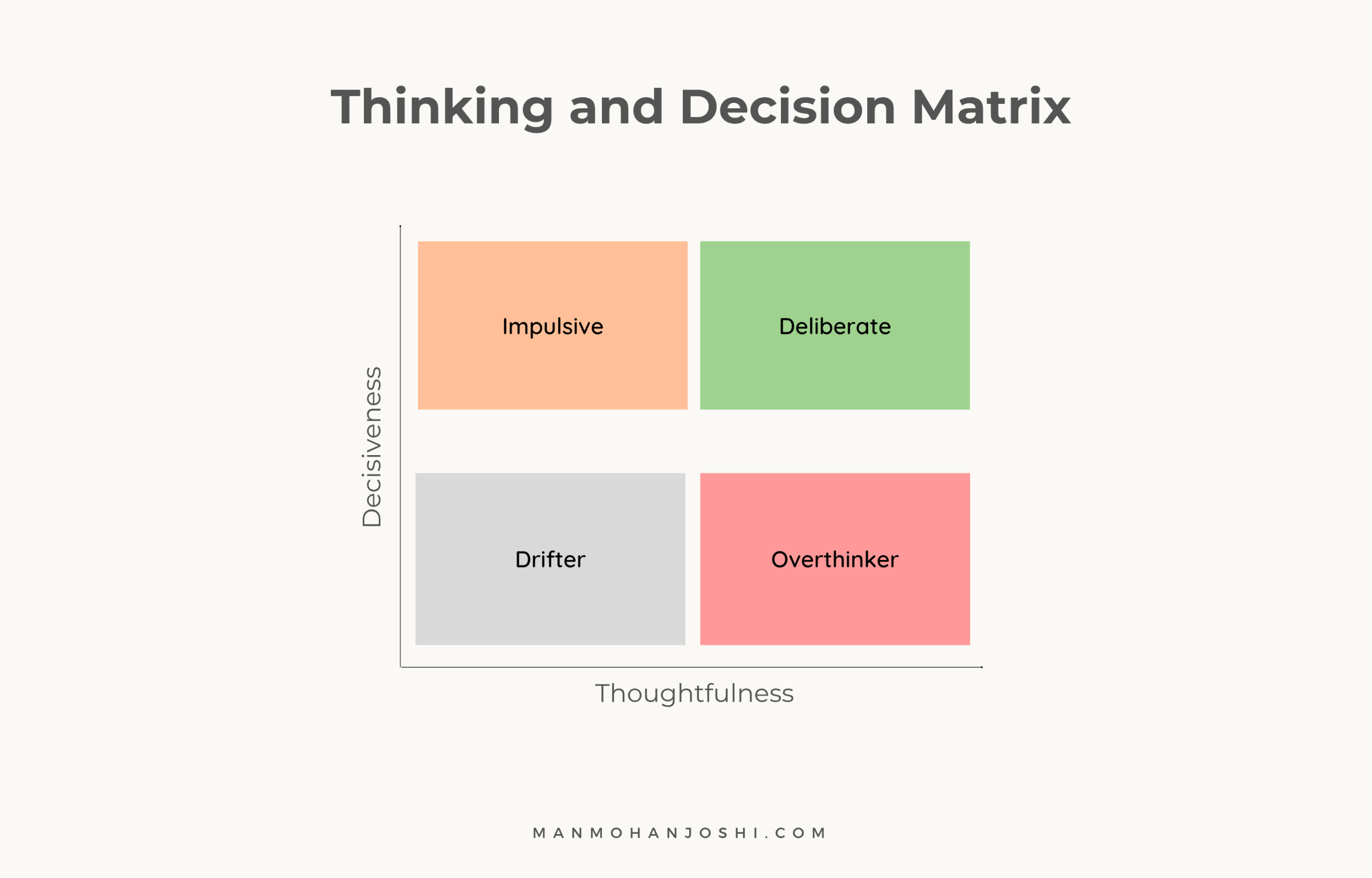
Illustration by the Author
1. Drifter
Low thoughtfulness + low decisiveness
You haven’t really thought deeply about what you want, but you aren’t making a decision either.
You simply keep moving with whatever happens next.
You postpone.
You wait.
You tell yourself you’ll figure it out later.
Drift can feel comfortable because it doesn’t require effort to think or make a decision.
But when you don’t make a decision, circumstances often make one for you.
The problem with drifting isn’t necessarily that you’re moving slowly.
It’s that you’re allowing the direction to be decided for you.
The way out is to start thinking and making your own decisions.
Ask yourself:
Is this taking me where I want to go?
If not, what decision can I make today to change my direction?
Sometimes, a simple cross-check can help you pause, reconsider your direction, and identify the next step you need to take.
2. Impulsive
Low thoughtfulness + high decisiveness
This is the opposite problem.
You decide quickly — but without giving yourself enough time to think things through.
The decision feels good because it creates immediate movement.
But movement may not always mean progress.
You buy because you want it now.
You say yes before thinking it through.
You respond before you’ve cooled down.
You quit before finding the real problem.
Fast decisions aren’t necessarily bad decisions. Sometimes experience or intuition allows us to decide quickly.
The problem is decisiveness without sufficient reflection.
And especially when the stakes are high, thoughtless decisions can prove expensive.
The way out is to pause and think.
Ask yourself:
What might I be missing because I’m rushing to decide?
Sometimes a short pause is all you need to turn an impulse into a considered decision.
3. Overthinker
High thoughtfulness + low decisiveness
This is probably the mode most of us recognise.
You think.
Then think some more.
You analyse the possibilities.
You imagine what could go wrong.
You search for more information.
You ask more people.
You revisit the same question tomorrow.
And still, you don’t decide.
The mind keeps producing more thoughts without producing a conclusion.
You get caught in the Analysis Paralysis trap:
Think → Think → Think → Think…
Thinking was supposed to help us reach a decision.
Instead, thinking becomes the activity itself.
The problem isn’t too much thinking.
The problem is thinking without a decision or action.
The way out is to decide and act.
Ask yourself:
Will thinking for a few extra minutes change the outcome?
If nothing important would change, you should move to a decision.
4. Deliberate
High thoughtfulness + high decisiveness
This is often the mode we want to move toward when the decision matters.
You give the situation enough thought.
You collect the information you need and consider consequences.
You separate facts from assumptions.
And then you decide.
Not necessarily with complete certainty.
Because complete certainty rarely exists.
Being decisive doesn’t mean knowing exactly what will happen.
It means knowing enough to choose what happens next and spending the right amount of time between thinking, deciding, and acting.
Being deliberate doesn’t guarantee you’ll always make the right decision.
It means you’ve thought sufficiently, accepted the uncertainty that remains, and are willing to move forward.
Use the Framework
The value of this framework isn’t in putting yourself permanently into one of these four modes or making them a persona.
We can move between them.
You might be a Drifter about one decision, Impulsive about another, and an Overthinker about something else.
The usefulness of the framework is simpler — It helps you recognise where you are stuck — and what you need to do next.
The Drifter needs to think.
The Impulsive needs to pause and think.
The Overthinker needs to decide.
The Deliberate needs to act.
So the next occasion you find yourself stuck on a decision, don’t immediately try to think harder.
First, pause and ask:
Which mode am I in right now?
Then ask:
What is the next thing I need to do to move toward action?
If you found this useful, share it with someone who might benefit.
ABOUT THE AUTHOR
Manmohan is a Writer and Creator. He writes about discovering potential and purpose–through understanding ourselves– and the transformation journey that unfolds afterwards.
His newsletter, The Infinite Pivot, shares ideas on how to break the status quo and pivot from being the current to a greater version of ourselves (The Infinite You) that makes an impact.
Learn more
Keep reading
-
$2,600 — My First Big Payment from Writing
A PayPal notification that felt like freedom -
5 Quiet Lessons These Mountains Echoed
A walk in silence, and nature whispered its guidance -
A Memoir of Indian Childhood in the 90s
Nostalgia and lessons for today -
Design Your Life in 5-Year Blocks
Slow down, zoom out, and build the life you imagine -
Gratitude Through Action, Not Just Words
Five simple practices that make gratitude real -
How I Reached the Edge of Tibet
And watched Mount Kailash emerge on the horizon -
How to Live in the Now
Two practical methods to anchor yourself in presence -
I Tried Drawing Consciousness — Here’s How It Looks
A visual attempt to decode our deepest mystery -
Maslow’s Theory of Human Motivation in 10 Points
Didn’t read the original publication? This summary’s all you need -
Pindari Glacier Expedition: When the Himalayas Taught Me About Purpose
Roar of the river. Silence of snow. And I found myself
Subscribe to my newsletter
The Infinite Pivot®
to keep receiving more thoughts like this, free.