
Image credit: Canva
.
Look at this dot above.
Now imagine this page as the vast cosmos, and this tiny dot could be our Earth, seen from an unimaginable distance.
Possibly the only place in the known universe where life exists.
The universe is filled with stars and planets, all made from the same fundamental elements. Those building blocks exist everywhere. Yet, on this tiny dot, they came together in just the right way to create something extraordinary.
Life.
And with life came consciousness.
Among all known forms of life, humans developed one remarkable ability:
The ability to think, reason, imagine.
Every scientific discovery, every work of art, and every civilisation began as a thought in someone’s mind, followed by a series of decisions and actions.
Thinking is one of humanity’s greatest gifts.
Understanding Thinking
Unlike most other forms of life, we don’t simply eat, sleep, survive, and reproduce.
We can think.
We are a way for the cosmos to know itself.
— Carl Sagan
As I write these words, I am using that very ability. Every sentence begins as a thought before becoming something you can read.
On a deeper level, thinking is one expression of consciousness.
Read my previous article explaining ‘Thinking’ as a component of consciousness:
I Tried Drawing Consciousness — Here’s How It Looks
A visual attempt to decode our deepest mystery
manmohanjoshi.com
The Thinking Cycle
Thinking is meant to lead us somewhere.
The natural flow of thinking is:
Think → Decide → Act
You have a thought.
You make a decision.
You take action.
Simple.
Thinking is the workshop where every action is first assembled.
— Manmohan Joshi
But sometimes we get caught in the loop:
Think → Think → Think → Think…
Nothing moves forward.
This is the thinking trap.
However, thinking itself isn’t the problem.
Simply put, when thinking isn’t followed by action, it becomes a loop. Over time, that loop becomes a habit, and we get caught in its trap.
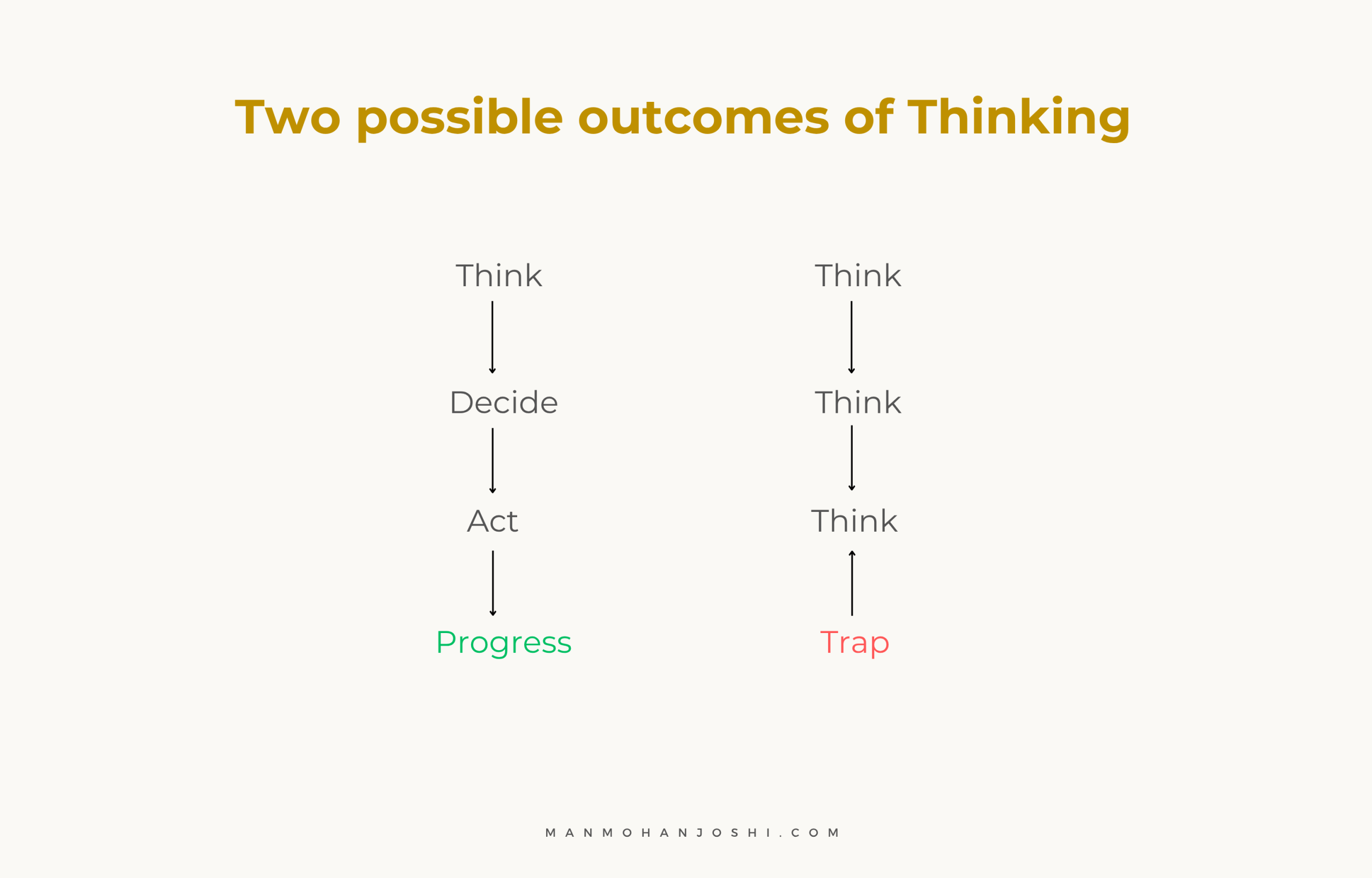
Illustration by the Author
The Power of Thinking on Paper
Our minds are wonderful at generating ideas.
They are far less effective at storing them.
Your brain evolved to produce thoughts, not archive them.
When dozens of ideas compete for attention, everything starts to feel equally urgent. The same thoughts return again and again because your mind keeps trying not to forget them.
Paper changes that.
The shortest pencil is better than the longest memory.
— An old proverb
The moment you write a thought down, your mind no longer has to carry it.
Here are 5 reasons to start thinking on paper:
1. Free your mind
Once a thought is written down, your brain no longer has to keep holding onto it, freeing up valuable cognitive bandwidth.
2. Make thinking visible
Ideas become something you can see instead of something you have to keep replaying in your head.
3. Gain clarity
Vague ideas become clearer, scattered thoughts begin to organise themselves, and patterns start to emerge.
4. Get organised
Review your thoughts, group related ideas, and identify the ones worth acting on.
5. Make progress
Finally, turn your ideas into a clear list of actions. Execute them, check them off and repeat.
The goal isn’t to think more.
It’s to think just enough to reach a decision.
Then let action take over.
Because thoughts alone don’t change our lives.
Actions do.
ABOUT THE AUTHOR
Manmohan is a Writer and Creator. He writes about discovering potential and purpose–through understanding ourselves– and the transformation journey that unfolds afterwards.
His newsletter, The Infinite Pivot, shares ideas on how to break the status quo and pivot from being the current to a greater version of ourselves (The Infinite You) that makes an impact.
Learn more
Keep reading
-
$2,600 — My First Big Payment from Writing
A PayPal notification that felt like freedom -
5 Quiet Lessons These Mountains Echoed
A walk in silence, and nature whispered its guidance -
A Memoir of Indian Childhood in the 90s
Nostalgia and lessons for today -
Design Your Life in 5-Year Blocks
Slow down, zoom out, and build the life you imagine -
Gratitude Through Action, Not Just Words
Five simple practices that make gratitude real -
How I Reached the Edge of Tibet
And watched Mount Kailash emerge on the horizon -
How to Live in the Now
Two practical methods to anchor yourself in presence -
I Tried Drawing Consciousness — Here’s How It Looks
A visual attempt to decode our deepest mystery -
Maslow’s Theory of Human Motivation in 10 Points
Didn’t read the original publication? This summary’s all you need -
Pindari Glacier Expedition: When the Himalayas Taught Me About Purpose
Roar of the river. Silence of snow. And I found myself
Subscribe to my newsletter
The Infinite Pivot®
to keep receiving more thoughts like this, free.