Pindari Glacier, Bageshwar, Uttarakhand, India. Video credit: Author
I call the mountains my home. If I could be anywhere in the world, I’d choose to go back there and spend some time. Any moment in the mountains becomes quality time by default.
Peace. Tranquillity. Stillness…
These aren’t just words — they become experiences when you see the lush green forests, walk into mist-soaked trails, feel the evening breeze on your face, or just watch clouds drift lazily across the peaks.
It takes me back to where I grew up — climbing trees, running up and down hills, playing until dusk. The sky felt bluer there, the nights deeper. From many places, you could spot the Milky Way without even trying.
When that kind of beauty surrounds you, questions naturally rise:
How? Why? What for?
In other words, Purpose.
Everywhere you look, nature feels picture-perfect — the epitome of art and craftsmanship. And you can’t help but wonder: who is the creator of all this magic, and why is it created in the first place?
That’s not the kind of question you can ask while stuck in traffic, horns blaring, or when someone’s trying to get ahead of you for no reason. But in the silence of the Himalayas, you come closer to understanding yourself and your raison d’être.
Your purpose in life is to find your purpose and give your whole heart and soul to it.
— Gautama Buddha
On my recent expedition to Pindari Glacier — where the Pindar River begins its journey and the magnificent peaks, including Nanda Devi, Nanda Kot, Nanda Khat, amongst others, silently guard the valley — that question echoed within me louder than ever.
So come along — and see how the mountains answered the biggest question of my life.
Questions Before the Expedition
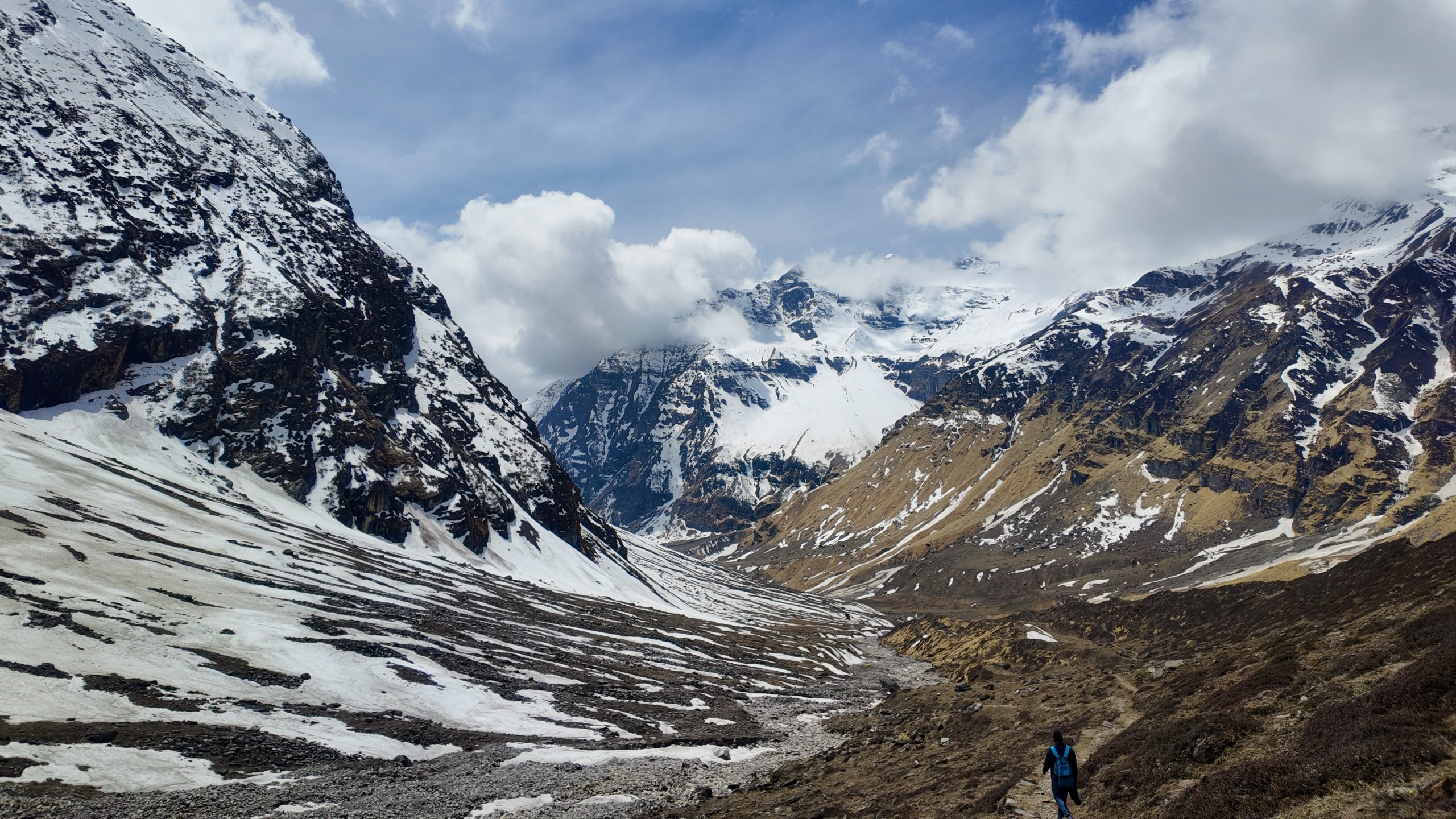
Coming down from Zero Point, Pindari Glacier. Image credit: Author
After more than a decade in the 9–5, I wanted to invest my spare time into building something meaningful — something that aligned with my purpose.
Thanks to my corporate experience, I have grown comfortable with writing. My day job revolves around analysis, presentations, and crafting insights for leadership — helping them make informed decisions.
So naturally, writing seemed like the obvious choice.
But then there is my love for adventure — hiking, trekking, exploring. Being outdoors always gives me clarity. And with that, another thought crept in: maybe I should start a vlog?
I’ve always been fascinated by stories like Heinrich Harrer’s — the mountaineer, Olympic ski champion, and author of Seven Years in Tibet. His journey across the Himalayas into Tibet and his encounter with the Dalai Lama remain among the most remarkable travel accounts ever written.
It is not for me to encourage disobedience, but if some of you need advice on how to do it, I would gladly give it.
— Heinrich Harrer, Royal Geographical Society (2002), from Seven Years in Tibet
Later, as YouTube grew, I found myself drawn to Rick Steves’ Europe series — I love the simplicity of his narration and how vividly he portrays these fantastic places.
During the pandemic, I stumbled upon Ronnie and Barty, a couple from the state of Himachal, India, who share beautiful stories of mountain travel and living.
So I stood at a crossroads:
A travel vlog or a blog (or both).
Although my conscience kept whispering “blog,” there was a certain void I was trying to fill with something else — or perhaps it was just my ignorance waiting for clarity.
Until this expedition.
The Expedition
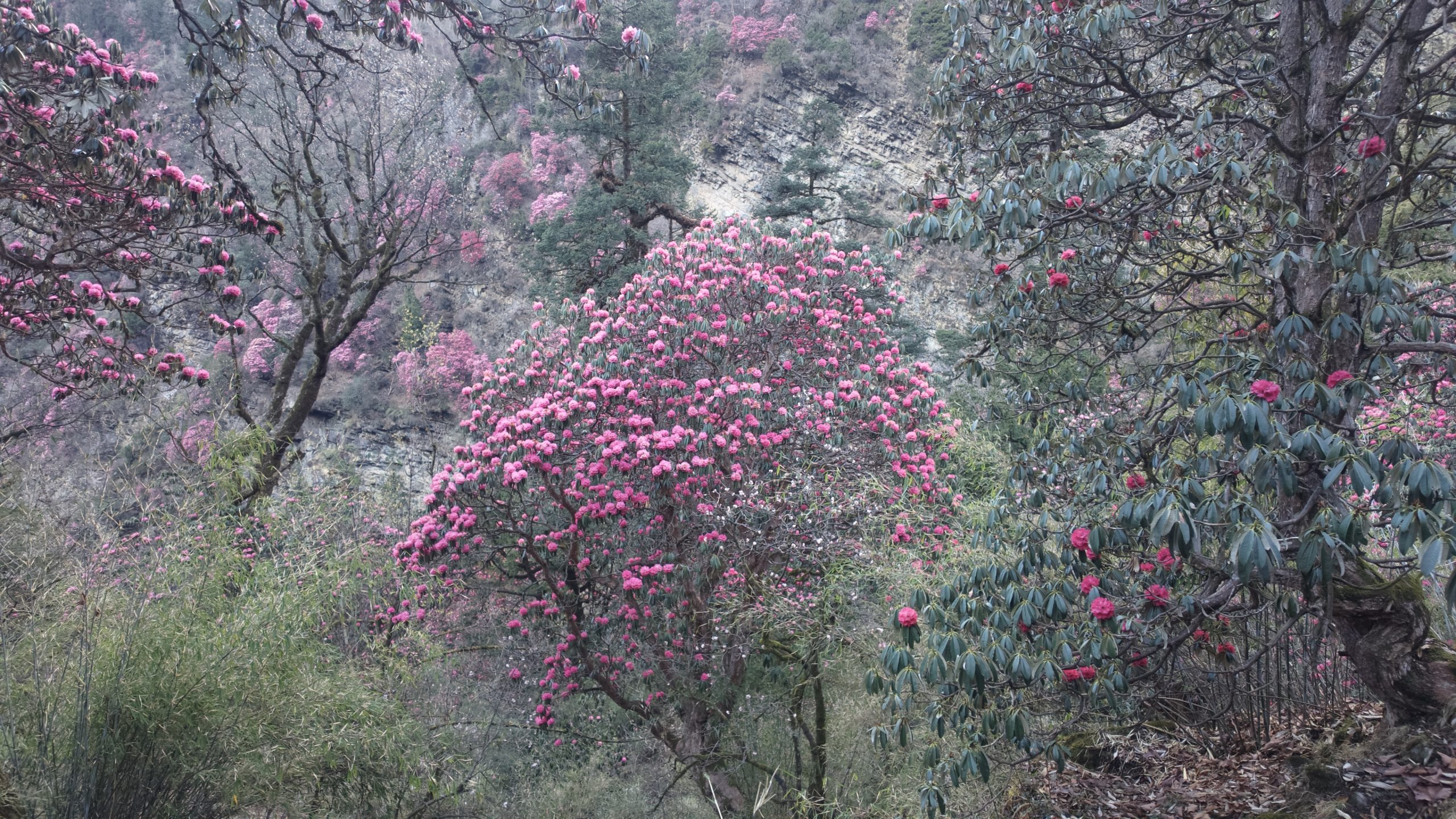
The trek between Dwali and Phurkia remains laden with Rhododendron forests of different hues. You’ll feel as if you’re in a wonderland. Image credit: Author
We completed this expedition in the 2nd week of April 2025 — a time when the snow begins to melt and the skies start to clear.
Route:
Drive: Delhi → Haldwani → Bageshwar → Khati
Trek: Khati → Dwali → Phurkia → Zero Point
Our crew included four people — all from my extended family. We met at Haldwani and began our journey together to our first stop, Bageshwar — a town that holds a special place in my heart. It’s where my mother comes from and where I spent many childhood years running through its lanes.
Every January, a grand fair called Uttarayani takes over this town — an Indian festival celebrating the sun’s northward movement and marking the transition from winter to summer. This time, though, Bageshwar was just a brief pause before the journey ahead.
From Bageshwar, we drove up to Khati, the last inhabited village on the route. From there, we trekked nearly 34 kilometres to reach Zero Point (as tracked via Garmin).
For this expedition, I carried a DJI Osmo Pocket 3 — my first real attempt to film the outdoors on the go. I’d tried it on a few short hikes before, but this was the real test.
After leaving Bageshwar, I started filming — the route only kept getting better. Every break became a chance to shoot a clip, and every bend in the mountain revealed a new scene waiting to unfold.
From Khati to Dwali, we crossed rivers and valleys — descending first to the bed of the Pindar River, then following it, rising and falling with the trail, until we reached Dwali, our first stop about 17 kilometres in.
Just before reaching Dwali, we faced heavy rains. Thankfully, our ponchos saved us from getting drenched. It gave us a glimpse of what was to come.
The stretch from Dwali to Phurkia was an uphill climb of about 7 kilometres, winding through dense Rhododendron forests — perhaps the most beautiful patch of jungle I’ve ever seen. The kind you only see in dreams.
As we gained height, the forest slowly gave way to snow — we crossed around seven snow beds before reaching Phurkia, the final stop prior to Zero Point.
Phurkia to Zero Point was about 10 kilometres — the trail evened out in places, with a few steep climbs along the way. We crossed nearly a dozen snow beds before reaching the glacier, many of them tricky and nerve-racking, as they sloped down toward the Pindar River, roaring fiercely just below.
The landscape here was untouched and wild — nature at its purest. Himalayan Bear, Tahr, and the striking Monal moved freely — a bird of the high altitudes with wings painted in many hues.
Crossing the final snow bed before reaching Pindari Glacier. Thanks to Arjun Danu, our guide, for filming this. Video credit: Author
The Observation
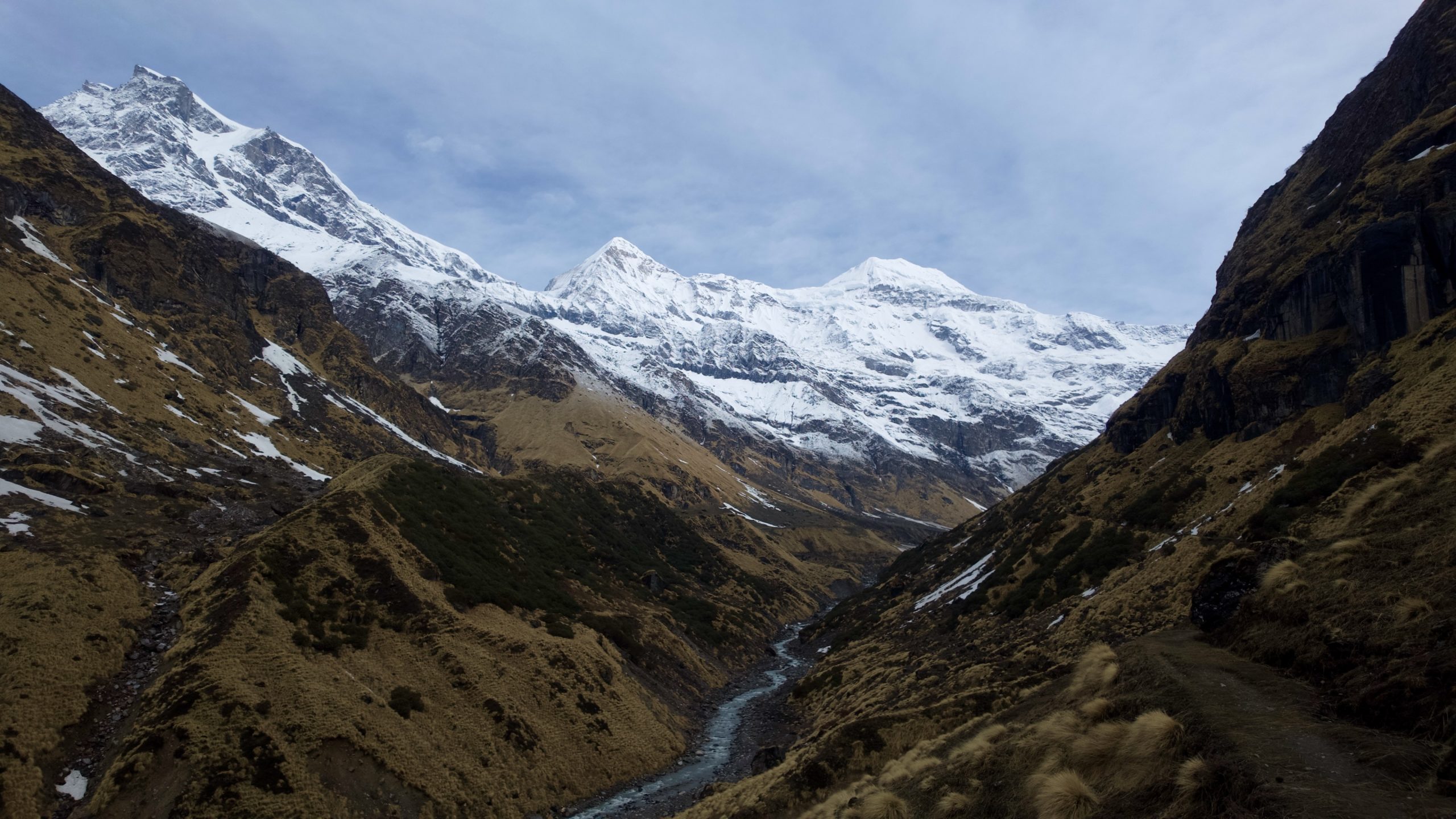
Mount Baljuri, Panwali Dwar and Nanda Khat (left to right) as seen from Phurkia → Pindari Glacier Zero Point route. Image credit: Author
As we drew closer to the glacier, the silence deepened — now we began to feel that we had wandered far into the wild.
Nobody else was around. No network. Just the sound of the Pindar River — and the quiet hum of the forest.
Somewhere in that stillness, something began to shift.
I realised that throughout the journey, I had been living behind the lens. Every moment had to be framed; every angle checked. It was so tempting to capture everything — as if the trail would lose its meaning if I didn’t record it.
But instead of soaking in the silence of the forest or the crunch of snow beneath my boots, I found myself worrying about battery life and whether my shots were good enough.
When we spotted a monal flying past us in surreal colours — or when a bear crossed a distant slope, or a herd of tahrs appeared on a ridge — those should have been moments of awe.
Instead, I caught myself thinking:
Oh, I missed that shot on camera.
The mountains were right there — alive in their stillness — but I was slipping away from them. I was seeing the trail, yet not really experiencing it.
We were carrying about 20 kilos of gear on our backs, but somehow, this small camera began to feel like the heaviest thing I had brought along. It wasn’t just the weight — it was the burden of distraction, of being everywhere but in the moment.
Clarity at the Summit
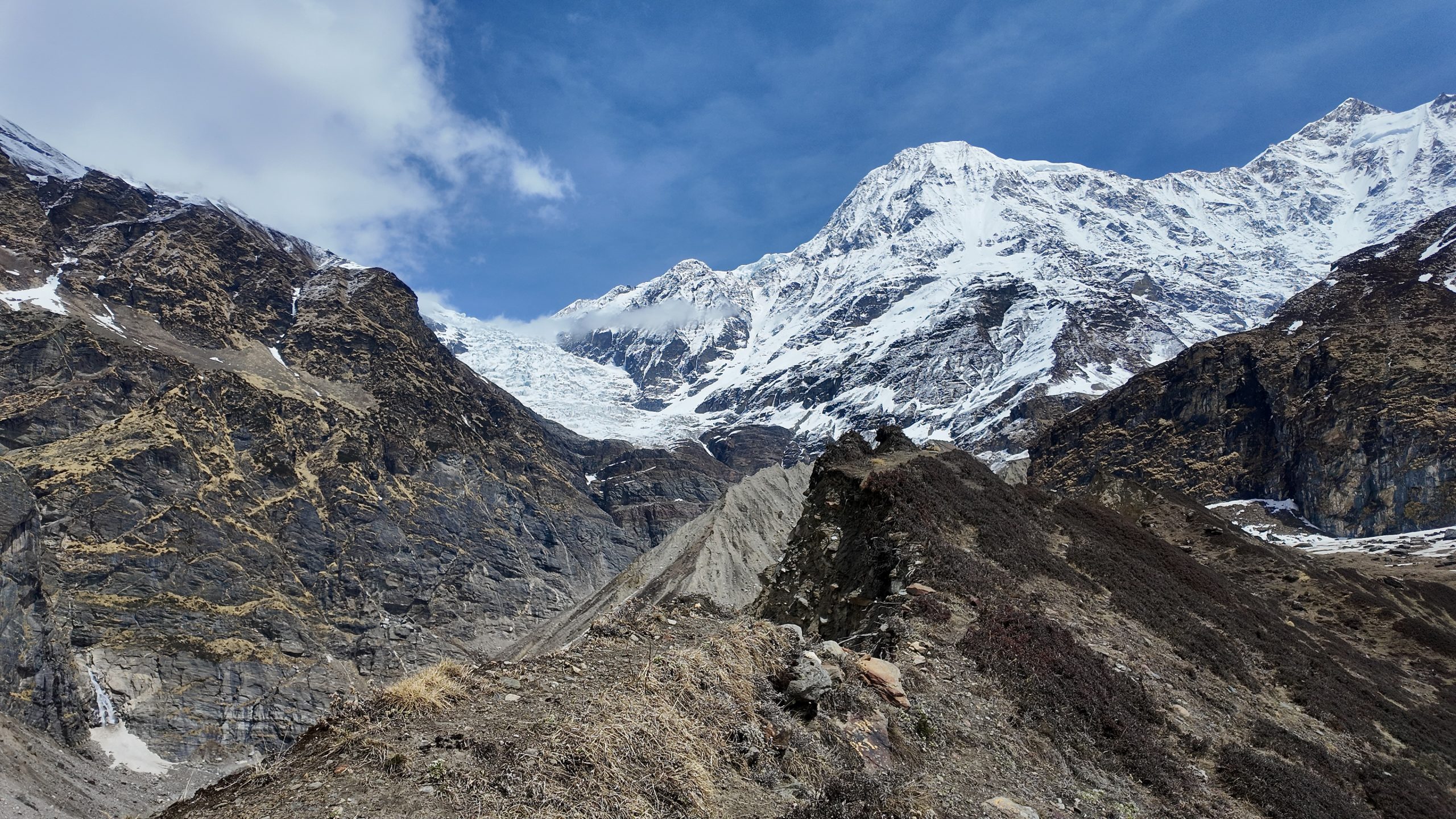
Pindari Glacier — a view from Zero Point. Image credit: Author
After reaching Zero Point, I finally set the camera aside. It was such a beautiful view that anything else lost its meaning. I sat down, breathing, absorbing, and listening to the sounds of nature.
The snow was quiet, yet the river roared.
A duality of nature, each expressed in its own way — one silent and still, the other full of sound and motion — each following its own nature and purpose.
Then I observed this:
The snow cannot be loud, and the river cannot be quiet.
And in that moment, I learned my lesson: I don’t have to be two people at the same time. I need to be what I am — what is inside.
I saw it as clean as snow and as clear as water — writing.
A man who wears two watches never knows the correct time.
— Segal’s Law
Vlogging isn’t for me. And I have good reasons for that:
-
- I’m no good at filming, and editing feels even harder. Even stitching short clips together is a personal trouble.
- Writing, on the other hand, comes naturally — it fits into my rhythm. A few quiet hours with myself work just fine.
On the way back, I didn’t film a single frame — and I can tell you for sure, it felt so liberating.
Sometimes we try to fill the void with too many things, but at some point, we have to choose the one that truly matters. In my case, it was writing.
If you’ve ever faced a question like this, give yourself the space to explore both paths. In the end, your conscience will guide you toward the right one.
That’s what happened to me. And that’s what I’m doing right now — sharing this story with you here, on Medium, and on my personal blog, manmohanjoshi.com.
P.S. Anyway, I’ve stitched some of the clips together — after all, it took a lot of hard work. Here’s our journey in a few frames.
Reaching Pindari Glacier Zero Point, Bageshwar, Uttarakhand, India. Video credit: Author
References:
Harrer, H. (2005). Seven Years in Tibet. (Original work published 1953). Harper Perennial
ABOUT THE AUTHOR
Manmohan is a Writer and Creator. He writes about discovering potential and purpose–through understanding ourselves– and the transformation journey that unfolds afterwards.
His newsletter, The Infinite Pivot, shares ideas on how to break the status quo and pivot from being the current to a greater version of ourselves (The Infinite You) that makes an impact.
Learn more
Keep reading
-
$2,600 — My First Big Payment From Writing
-
5 Quiet Lessons These Mountains Echoed
-
A Memoir of Indian Childhood in the 90s
-
Design Your Life in 5-Year Blocks
-
Gratitude Through Action, Not Just Words
-
I Tried Drawing Consciousness — Here’s How It Looks
-
Maslow’s Theory of Human Motivation in 10 Points
-
The 5 Modes of Productivity: A Simple Way to Track Your Daily Bandwidth
-
The 7 Things You Truly Need in Life
-
The Art of Living: 3 Simple Rules to Thrive in Life
Subscribe to my newsletter
The Infinite Pivot®
to keep receiving more thoughts like this, free.