
Image credit: Canva
Most of us are intrigued by this question at some point in our lives: What are my needs, wants, and desires?
Thanks to technological and economic advancements over the past few decades, many of us now have access to more than what is needed to live a comfortable life.
We hardly realise how much comfort has entered our lives compared to that of a forager a few thousand years ago, a caravan traveller in the medieval world, or even our parents or grandparents.
The list gets long, but we are just busy as consumers wanting the next available thing on the shelf.
But when this becomes too much, and we are no longer comfortable with our appliances of modernism, we try to go back to our roots and find answers to the most basic questions:
What do I really need to maintain and sustain a quality, happy life?
In 1908, in Brooklyn, New York, Samuel Maslow and Rose Maslow, Jewish immigrants from Russia, gave birth to their child, Abraham (now referred to as Maslow).
The kid grew up in a diverse neighbourhood and was exposed to various cultural influences from an early age.
Maslow’s childhood is said to have been difficult, and he often faced financial and family problems, but he went on to devote himself to his studies.
After graduating from high school, Maslow initially studied law at the City College of New York. However, he soon shifted his focus to psychology, influenced by his dissatisfaction with the legal profession and fascination with human behaviour.
Maslow continued his education at the University of Wisconsin, where he earned his bachelor’s, master’s, and doctoral degrees in Psychology.
During his academic journey, Maslow became interested in the study of human motivation and personality, laying the groundwork for his later work in psychology.
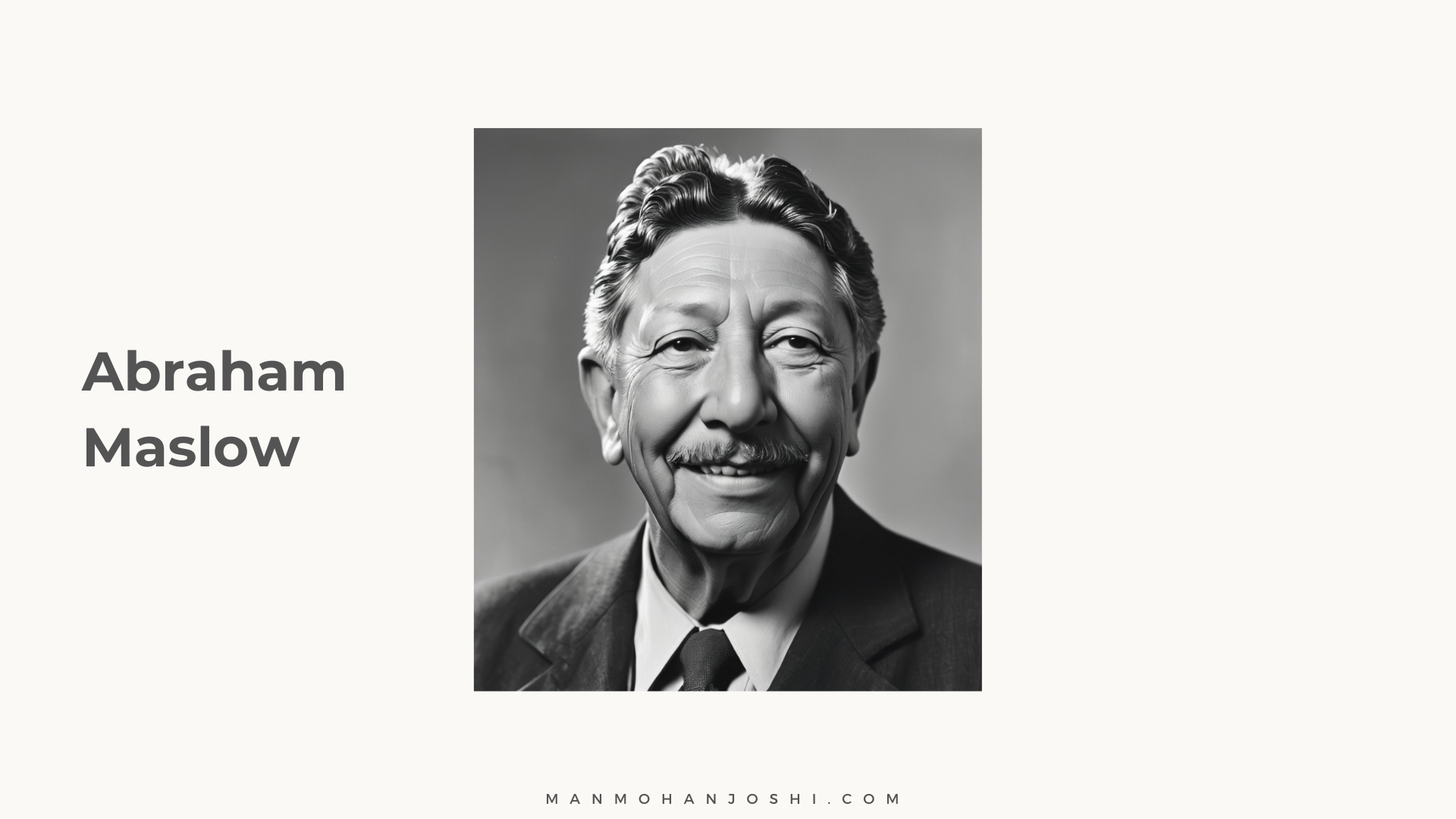
Created with Gencraft.com
Maslow started teaching at Brooklyn College and later became Head of the Psychology department at Brandeis University, where he remained until 1969.
Overall, Maslow’s early life was characterised by a mix of adversity and academic curiosity, shaping his perspective on human behaviour and motivation. These formative experiences would later influence his groundbreaking contributions to the field of psychology.
In addition to his work on motivation, Maslow made significant contributions to the field of humanistic psychology. He emphasised the importance of self-actualisation and the potential for personal growth and fulfilment in individuals.
He was among the initial thinkers who believed that psychology should focus not only on pathology and dysfunction but also on the positive aspects of human experience.
Maslow’s ideas have had a profound influence on psychology, education, business management, and various other fields. He is widely regarded as one of the most influential psychologists of the 20th century.
So, I think getting familiar with Maslow’s theory is an important step for anyone who is keen to develop a detailed understanding of himself or herself.
I, too, was intrigued by the questions of needs, wants, and desires that fueled my curiosity to understand Maslow’s work in more detail.
Don’t worry if you haven’t had a chance to read his original publication yet. I’m summarising the essential highlights of his famous theory of human motivation in 10 points to help you gain a holistic understanding of his work.
Here we go.
1 Maslow articulated motivation theory, where he talks about the basic needs (the pyramid structure we see in most places) in his 1943 paper “A Theory of Human Motivation”, originally published in Psychological Review, 50, 370–396.
2 Maslow cites that human needs arrange themselves in hierarchies of pre-potency and, therefore, form a pyramidical structure.
This partially means that the appearance of one need is dependent upon the satisfaction of a previous, more significant need.
3 Once a need is fairly well satisfied, it no longer serves as the motivation, and we seek the next prepotent or higher need.
This new need then becomes the focus of our consciousness, and we try to achieve it with all available capacities.
The less significant needs get minimised, even forgotten or denied.
Man is a perpetually wanting animal.
— Abraham Maslow
4 There are five sets of goals, which Maslow calls the “basic needs”. These basic needs arrange themselves in an ascending order, depicted in the image below.
-
- Physiological
- Safety
- Love
- Self-esteem
- Self-actualisation
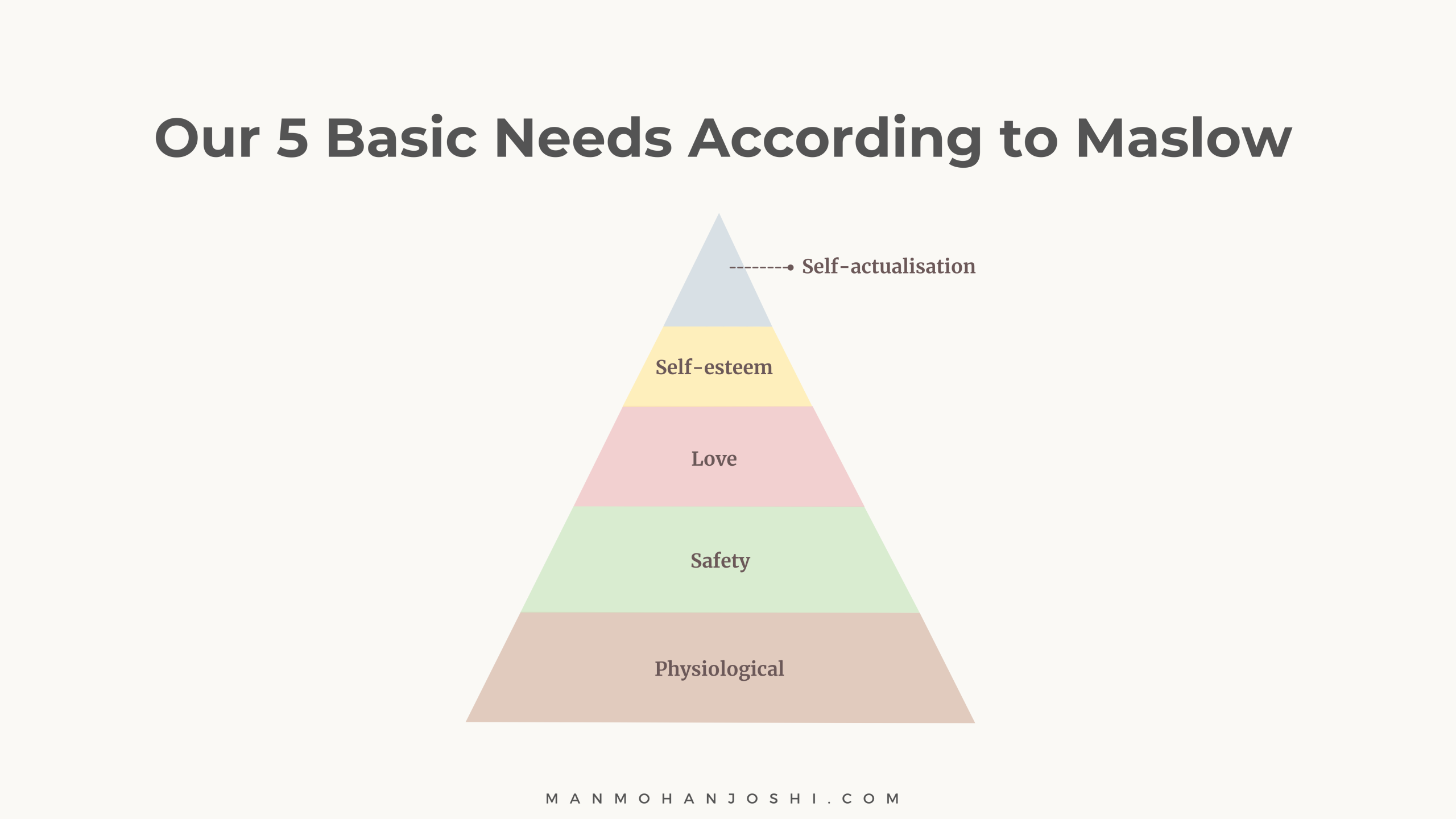
Illustration by the Author
5 The Physiological Needs
These are the most basic needs that are essential to sustaining life.
Oxygen, Water, Food, Breathing, Exercise, Sleep, Shelter, Clothing, Bodily functions, etc.
Maslow argues that a person who lacks food, safety, love, and esteem will need to satisfy his/her hunger first before looking to any other need.
For that person, all bodily capacities get directed toward satisfying hunger, and everything else will remain dormant or pushed into the background.
6 The Safety Needs
Safety needs, the second tier in Maslow’s hierarchy of needs, come into play once physiological needs are met.
These needs encompass various aspects of safety and security that individuals seek to achieve a sense of stability and protection.
Maslow identified several components of safety needs, which are:
Personal Security
We all want to feel safe — from accidents, violence, or danger outside, and from sickness or injury inside.
Financial Security
Money is not everything, but without it, life becomes tough. Having a steady income, enough for food, shelter, and family needs, gives us peace of mind.
Health and Well-being
If we are not feeling well, it would be hard to enjoy the pleasures of life. Facilities like access to health care can bring a sense of safety.
Safety Nets
Life brings challenges like illness, job loss, or crisis. In such times, we need support from government programs, insurance, the community, or family and friends. Safety nets make us stronger during difficulties.
Stability and Predictability
We feel secure when life feels in order and is predictable. Any sudden change can bring us worries and anxiety.
7 The Love Needs
Love and belongingness needs represent the third tier in Maslow’s hierarchy of needs, following physiological and safety needs.
These needs revolve around the desire for one-to-one relationships, affection, and a sense of belonging.
Two main components within love and belongingness needs are:
Social Relationships
Humans are social animals. We look for meaningful connections — friendships, family bonds, or romantic relationships. These give us emotional support, companionship, and a sense of belonging.
Feeling Accepted and Valued
We want to be appreciated for who we truly are. Feeling understood, respected, and included in a group adds to our self-worth. When others accept us, we feel fulfilled and happy.
Fulfilling love needs is essential for psychological well-being and overall happiness. When these needs are met, individuals experience greater levels of satisfaction and fulfilment in their lives.
If not satisfied, it can lead to feelings of loneliness, isolation, and emotional distress.
8 The Esteem Needs
These are the fourth tier in Maslow’s hierarchy of needs, encompassing the desire for self-respect, recognition, and esteem from others.
Maslow identified two main types of esteem needs:
Self-Esteem
This is about how we see and value ourselves. It includes self-worth, self-respect, and confidence. Self-esteem grows through achievements, learning new skills, and personal accomplishments. It also comes from independence — the ability to make our own choices and decisions.
Esteem from Others
This is the respect and recognition we receive from people around us. It can show up as compliments, praise, awards, social status, or simply being appreciated by family, friends, or colleagues.
When esteem needs are met, we feel confident, motivated, and satisfied in life. However, when these expectations are not met, we may feel inadequate, inferior, or struggle with low self-esteem.
9 The Self-actualisation Needs
It’s the highest level in Maslow’s hierarchy of needs. It represents the peak of human growth and fulfilment.
It’s about realising one’s full potential, pursuing personal growth, striving for a meaningful life, and becoming everything one is capable of becoming.
Key characteristics of self-actualised individuals:
Autonomy
Strong sense of independence. Not overly dependent on outside approval or social norms. Trust their own judgment and inner guidance.
Creativity and Problem-Solving
Open to new ideas and experiences. Use creativity to express themselves and solve problems. Value originality and curiosity.
Spontaneity and Authenticity
Genuine and real in their interactions. Comfortable being themselves. Do not feel the need to pretend or conform.
Peak Experiences
Moments of deep joy, meaning, and connection. Feelings of fulfilment and awareness that go beyond daily life.
Continued Growth and Development
Committed to lifelong learning and personal growth. Always looking to expand their horizons and evolve as individuals.
Maslow believed self-actualisation is rare and not everyone fully reaches it. Still, he argued that the journey is possible for everyone, as long as their basic needs are met and they actively pursue growth and fulfilment.
If a musician is to be ultimately happy, he must make music, an artist must paint, and a poet must write.
What a man can be, he must be.
— Abraham Maslow
10 Limitations of the Theory
Maslow cautions readers about his theory’s limitations and highlights additional perspectives that should be considered to comprehend it adequately.
Flexibility of the Hierarchy
The pyramid of needs is not fixed or rigid; it is adaptable. For some people, self-esteem may take precedence over love. For creative individuals, making art is more important than owning a home.
Partial Satisfaction
One need does not have to be 100% fulfilled before the next one appears. In reality, most people feel partly satisfied and partly unsatisfied across multiple needs simultaneously.
Cultural Differences
Maslow did not claim that the hierarchy is the same for every culture. He suggested these needs are more universal than superficial desires, but culture still shapes how people experience and prioritise them.
Multiple Motivations
Human behaviour is not driven by only one need. For example, eating food is a basic need, but people also eat for social, emotional, or cultural reasons.
You might prefer a simple home-cooked meal, but when you choose to dine at a fancy restaurant, you’re often satisfying more than just physical hunger — perhaps you’re seeking quality time with family and friends, or creating the right ambience for an important business meeting.
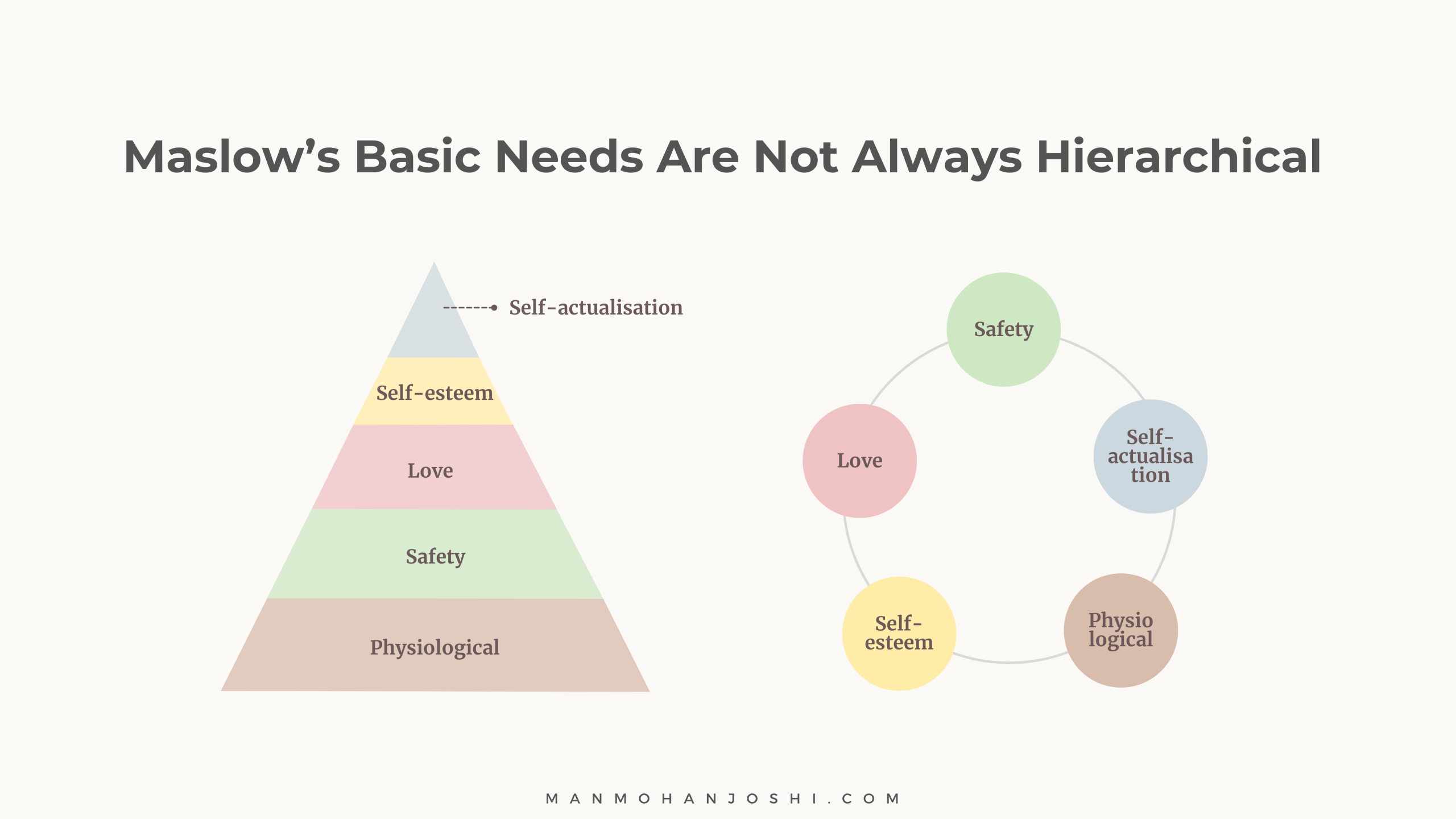
Illustration by the Author
Thanks for reading Maslow’s theory of human motivation in the 10 points above.
This theory has been debated and adapted many times over the years. However, what still makes it powerful is how it reveals the depth and variety of what people truly want from life.
He encourages us to appreciate the richness of human experience and consider a multi-faceted approach for well-being and fulfilment.
As we continue to explore and refine our understanding of human needs, wants, and desires, Maslow’s insights serve as a timeless reminder of the fundamental desires that drive us all.
References:
Maslow, A. H. (1943). A theory of human motivation. Classics in the History of Psychology. https://psychclassics.yorku.ca/Maslow/motivation.htm
Bay Path University. (n.d.). Chapter 23: Industrial and organizational psychology. In Psychology 321: Introduction to Industrial and Organizational Psychology. https://open.baypath.edu/psy321book/chapter/c23p1/
ABOUT THE AUTHOR
Manmohan is a Writer and Creator. He writes about discovering potential and purpose–through understanding ourselves– and the transformation journey that unfolds afterwards.
His newsletter, The Infinite Pivot, shares ideas on how to break the status quo and pivot from being the current to a greater version of ourselves (The Infinite You) that makes an impact.
Learn more
Keep reading
-
$2,600 — My First Big Payment From Writing
-
5 Quiet Lessons These Mountains Echoed
-
A Memoir of Indian Childhood in the 90s
-
Design Your Life in 5-Year Blocks
-
Gratitude Through Action, Not Just Words
-
I Tried Drawing Consciousness — Here’s How It Looks
-
Pindari Glacier Expedition: When the Himalayas Taught Me About Purpose
-
The 5 Modes of Productivity: A Simple Way to Track Your Daily Bandwidth
-
The 7 Things You Truly Need in Life
-
The Art of Living: 3 Simple Rules to Thrive in Life
Subscribe to my newsletter
The Infinite Pivot®
to keep receiving more thoughts like this, free.