Image credit: Canva
Brewing your morning tea.
Reading the headlines.
Making breakfast.
Dropping the kids off at school.
Commuting to work.
Giving a client presentation.
Attending a town hall.
Taking an evening walk.
Grabbing groceries.
Hitting the gym.
Bingeing your favourite show on Netflix…
From the moment we wake up to the time we fall asleep, our days are filled with a variety of tasks — some productive, others mundane.
But here’s the curious part:
In some of them, we’re so deeply absorbed that we lose track of time.
In others, we’re simply waiting for it to end.
We’re the same person throughout — yet our focus, energy, and engagement fluctuate considerably.
This inconsistency affects not only the quality of our work but also how fulfilled and effective we feel.
So, what explains this shift?
To answer that, let’s look at it from a different lens — one that could help us become more present, creative, and effective in our everyday lives.
The States of Consciousness
In a previous article, I explained how we can think of ourselves as an organisation, made up of two key departments: Body and Consciousness.
Within the consciousness department, the three components of consciousness — Thinking, Voice, and Presence — remain in a constant flux of multiple states, influencing how we behave and react at any given time.
To learn more about the components of consciousness, read the following:
I Tried Drawing Consciousness — Here’s How It Looks
A visual attempt to decode our deepest mystry.
manmohanjoshi.com
These states of consciousness can be considered the exact sum of how we feel from within and directly impact our overall creativity, productivity, effectiveness, well-being, and quality of life.
And here they are.
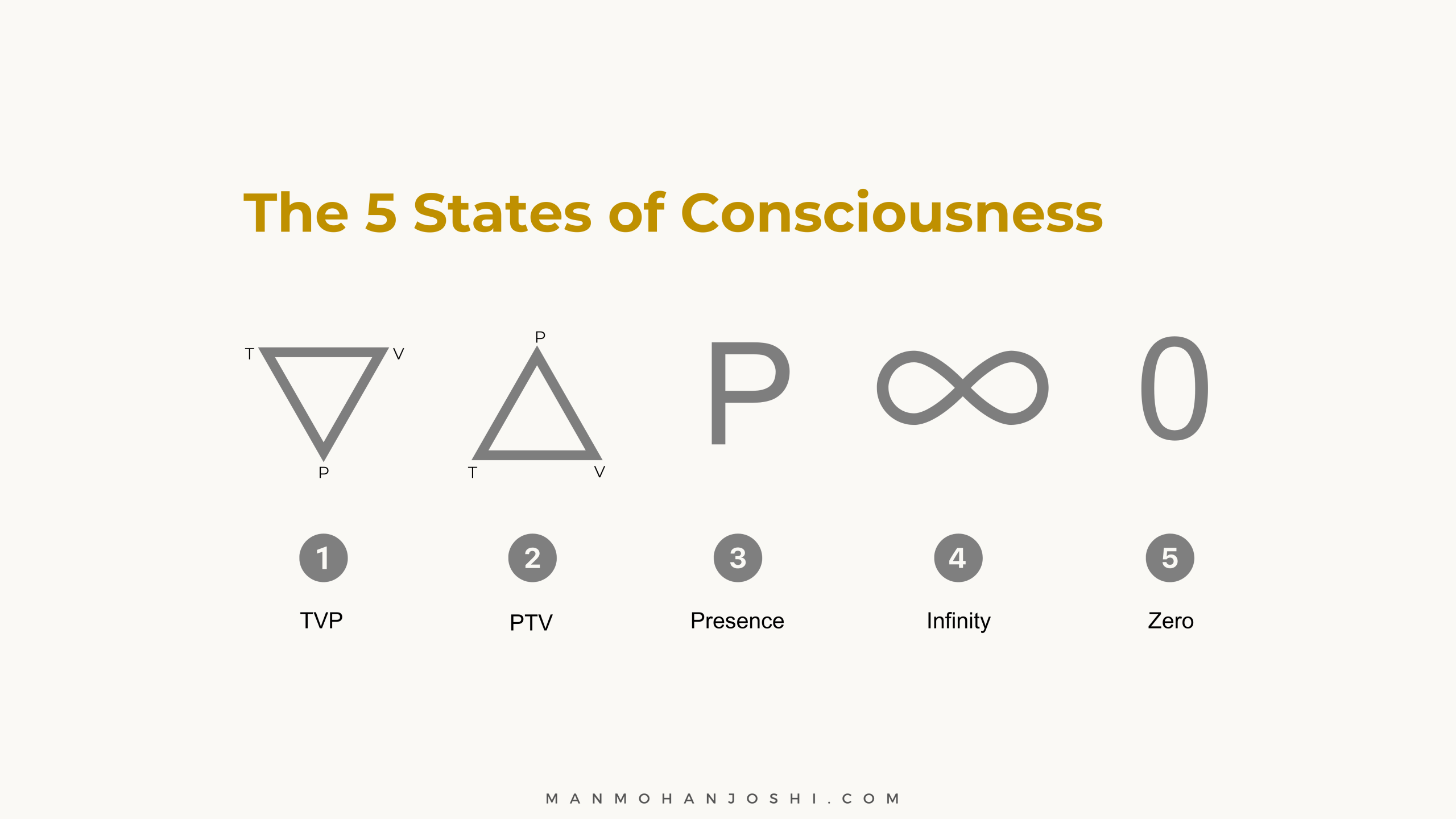
Illustration by the Author
1) Thinking, Voice, Presence [TVP]
This can be regarded as the primary state of consciousness for most of us — dominated by Thinking and Voice components, followed by Presence.
From the moment we’re born, we’re thrust into a world where values like success, money, rewards, and high performance are held up as the ultimate goals.
Society tells us these are the real ingredients of a meaningful life — and we begin to shape our purpose around them, often without question.
Every industry and sector has its own version of this mindset and buzzwords.
E.g., most new-age startups can’t survive without disruption and hyper-growth. They must dream of becoming unicorns and providing their founders and capital providers with exponential returns.
Advertisements, movies, and social media are designed to constantly remind you that you’re missing out on life if you’re not chasing something bigger, faster, shinier.
There is enough scientific evidence to show our brain’s capability to automate repetitive tasks to save time and energy.
For instance, once we learn to walk as infants, the process becomes automatic and requires little conscious thought. Similarly, when we learn to drive, we don’t recall every turn or action taken along the way; we just reach the destination.
Likewise, thanks to years of practice, we train ourselves to think in accordance with the above societal values.
By the time we realise, the Thinking component gets attuned to work on autopilot, and we find ourselves neck deep in the abyss of constantly thinking about something — something new, something better, something about the past or future — we are never present at the moment.
This habitual thinking further shapes our Voice component, as it continuously observes and internalises the patterns of our thoughts.
Therefore, the TVP state could be considered as the most prevalent state of our modern civilisation.
2) Presence, Thinking, Voice [PTV]
This state is dominated by Presence, with Thinking and Voice components taking a back seat.
I’m sure you haven’t forgotten the 2022 FIFA World Cup final.
What a great moment of joy and excitement for all as the world tried to recover from the tragic Coronavirus pandemic.
Right from the kickoff, both teams displayed unwavering determination, with Messi’s artistry and Mbappé’s lightning pace electrifying the atmosphere.
The midfield turned into a battleground, with each pass and tackle a testament to the fierce competition between the two powerhouses.
As if that were not enough, the game went on to a sensational penalty shootout, letting Messi create history while Mbappé won hearts.
I think this quick recap will suffice to resurface the vivid memories of the day. The fact is that we gave our complete, undivided attention to the game — nothing else mattered, no other thoughts of the past or future. Everything was down to those very moments.
Of course, when the match ended, we went on with our lives, got busy paying the bills, and are now looking forward to the 2026 event to be hosted in the Americas.
Long story short, this is a simple explanation of the PTV state.
There are moments of Presence in certain activities, but then we go back to our routine, where Thinking and Voice components take the front seat and diffuse Presence.
3) Presence [P]
This is the state of pure Presence when Thinking and Voice components get turned off, or do not interfere.
Presence closely relates to the “Flow” state as described by Mihály Csíkszentmihályi, where we are fully immersed and focused on a task to the point that we lose track of time and experience a sense of effortless concentration and enjoyment.
This state has significant implications for creativity and productivity.
Presence is the state in which one can experience heightened creativity or productivity, leading to high-quality outcomes and a deep sense of satisfaction.
It would usually occur when your skills and abilities match the task at hand, or something you truly love doing, so you’re able to immerse yourself in that activity.
It’s important to note that it’s an advanced state of consciousness, and achieving it requires understanding and constant practice.
It’s possible to feel certain bursts of presence in your daily schedule, but retaining them for a longer duration is science as well as art. Successful practitioners know how to extend the duration and use this state to their advantage.
How long can one be present?
This greatly varies from person to person. If you ask this question to a monk and a high-school student, both will have different answers.
4) Infinity [∞]
This is the ultimate state of consciousness, where you are one with the infinite or the vast universe and feel like an integral element of it.
It’s a state in which the mind is absolutely quiet, the heart is open with love, and the awareness is so deep that one feels a connection with the infinite vastness.
Throughout history, accessing this transcendent state has been the ultimate objective of several philosophers, sages, and mystics through various means, including yoga, meditation, prayer, and contemplative practices.
To access Infinity, one needs to rise above the limitations of personal identity and delve deep into the realms of self-awareness; only then might it be possible to realise interconnectedness with all of life and the vast expanse of the cosmos.
Infinity can be considered the most ideal state for creativity.
I deliberately exclude productivity here because:
In this ultimate state of consciousness, we transcend anything conventional or established and align with the cosmos’ higher purpose — giving birth to something new: ideas, opinions, theories…
Creativity invents; productivity implements. The former gives birth to new ideas, while the latter is the discipline of executing them efficiently.
— Manmohan Joshi
Individuals experiencing this state undergo a profound paradigm shift in their perspective, which can even lead to a deeper understanding of some of life’s complexities and the universe’s mysteries.
This shift can result in inventions, discoveries, theories, and works of art that positively impact humankind.
5) Zero [0]
This state can be considered a follow-up state after one experiences Infinity.
Infinity and Zero are probably two sides of the same coin and represent fascinating extremes in mathematics, science, and philosophy.
One can not stay in the Infinity state for long and has to return to normal life to fulfil the requirements of daily routine, even if he or she is a monk.
Hence, consider this as the normalisation that follows if you have been in the ultimate state.
A state of absolute relaxation. A transit state that allows return to normal.
It’s important to note that all of the above five states are deeply subjective in nature, and they can be explained only in metaphysical terms.
There may not be empirical scientific evidence, as no one can see or quantify consciousness. Hence, consider this an alternative view to strengthen your understanding of consciousness.
Now, I have a question for you:
Which state of consciousness are you in currently, or remain in mostly?
Let me know your thoughts [hello@manmohanjoshi.com].
References:
Tolle, E. (2000). The Power of Now: A Guide to Spiritual Enlightenment[Audiobook]. New World Library.
Tolle, E. (1997). The Power of Now: A Guide to Spiritual Enlightenment. Namaste Publishing.
Claremont Graduate University. (n.d.). Mihaly Csikszentmihalyi. Claremont Graduate University. https://www.cgu.edu/people/mihaly-csikszentmihalyi/
ABOUT THE AUTHOR
Manmohan is a Writer and Creator. He writes about discovering potential and purpose–through understanding ourselves– and the transformation journey that unfolds afterwards.
His newsletter, The Infinite Pivot, shares ideas on how to break the status quo and pivot from being the current to a greater version of ourselves (The Infinite You) that makes an impact.
Learn more
Keep reading
-
$2,600 — My First Big Payment From Writing
-
5 Quiet Lessons These Mountains Echoed
-
A Memoir of Indian Childhood in the 90s
-
Design Your Life in 5-Year Blocks
-
Gratitude Through Action, Not Just Words
-
I Tried Drawing Consciousness — Here’s How It Looks
-
Maslow’s Theory of Human Motivation in 10 Points
-
Pindari Glacier Expedition: When the Himalayas Taught Me About Purpose
-
The 5 Modes of Productivity: A Simple Way to Track Your Daily Bandwidth
-
The 7 Things You Truly Need in Life
Subscribe to my newsletter
The Infinite Pivot®
to keep receiving more thoughts like this, free.